Originally published March 7, 2019 at Cinapse.co.
Captain Marvel is something of a miracle. It somehow took the most massive franchise in cinema history almost a decade to star a female superhero, as well as let a woman co-direct, and after all of that fervor there was almost no way it could live up to what it needed to be. As a sequel to the previous films in the series, it needed to be funny, look like a Marvel Movie, have a franchise-relevant MacGuffin, and feature a beloved actor as a villain. To adequately tell a story for female fans of the series, it couldn’t just be unique because it starred a woman, it needed to address this, but also show her as a strong hero independent of her gender. As a response to all of the children on the internet who couldn’t handle a female superhero, it needed to — well it didn’t need to do anything, but it would be nice to poke fun at them. Thankfully, it succeeds on all of these levels, and though it bears the flaws of most Marvel movies, isn’t that kind of the point?
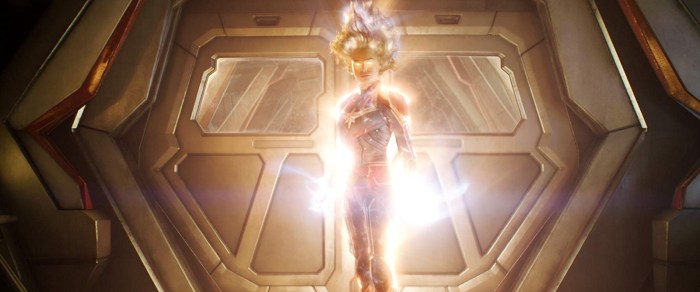
Brie Larson takes the title role as Carol Danvers (aka Vers), who begins the film as some sort of alien super-soldier on the alien planet of Hala, home of alien race The Kree. Though The Kree were the villains of 2014’s Guardians of the Galaxy, they’re just people in their own civilization here, ruled by a being known only as The Supreme Intelligence. Gifted with the power to shoot weird beams of power from her fists, he works together with a team that basically functions as a Kree answer to the Guardians of the Galaxy, led by their very own Normal White Guy, Jude Law’s Yon-Rogg. Yon-Rogg and the rest of the Kree, in their own Jedi Order-like way, insist that emotion is the enemy, and the only way to properly control her power is by suppressing it. The first act is full-on space-fantasy, focusing heavily on the Kree’s war with the Skrull, a villainous, shape-shifting race. It takes a surprisingly dark tone that is sure to turn some people off, as it’s a bit of a break against form for the franchise, but it works quite well — we’re introduced to the mostly brutal life of a soldier in space, and then the whole thing starts to unravel.
Inevitably, the war leads Carol to Earth, a place she’s seemingly never been, but it awakens dormant memories of life as a normal human. Everything takes a hard turn in the second act, as directors Anna Boden and Ryan Fleck shift everything on its head, pairing Carol with a young Nick Fury (Samuel C.G.I. Jackson). This wildly fun midsection swings fully into Jason Bourne-meets-Shane Black, as they try to decipher her past whilst slinging banter and fighting enemies. The visual effects that make Jackson look like the 90s version of himself are pretty astounding, miles ahead of Michael Douglas’ rubbery face in 2015’s Ant-Man. Jackson works brilliantly in the role again, convincingly naive but still the cynical character we know as an adult. As we see him start to understand his own place in the larger universe, Jackson is probably the best he’s been as Fury since first putting on the eyepatch 11 years ago. He plays brilliantly against Larson, who herself delivers a powerful performance that embodies the uncertainty and courage of a super-weapon learning to become a superhero. Her stoic demeanor at the beginning starts to fade away as she becomes a sort of fun-loving cornball, impressed with her own powers.
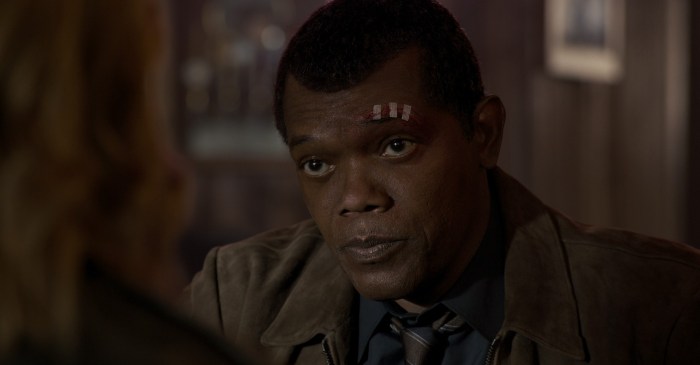
Basically every performance in Captain Marvel rules, but Boden and Fleck’s greatest success is the film’s always-interesting, frequently shifting tone. The very dark, war-heavy opening is a great way to introduce the person who Carol is at the film’s start, but it transforms just as she does. As she (and filmmakers Boden and Fleck) clearly starts to become more comfortable, the movie embraces a sense of fun. It’s not a joke factory, the way your Ant-Mans and Iron Mans are, but the jokes have a wickedly high success rate. The filmmakers are even able to milk some hilarious moments from the villainous Skrull Talos, played tremendously by Ben Mendelsohn. Mendelsohn adopts a variety of accents for his many forms, each more ridiculous than the last, but always keeps a humorously aloof face, even under pounds of prosthetic makeup. He’s also not the only one to mine facial humor, which seems to be a style choice by Boden and Fleck — basically everyone in this movie delivers odd, perfectly timed bits of physical humor, and it’s a great departure from the MCU’s typical quip-based humor.

Because of this perfectly executed tone and a cast packed full of lovable, smaller characters that I won’t spoil in this review, the 124-minute runtime flies by. This is a very good thing, but it makes it easy to overlook some of the issues that arise when looking back on the film. When you piece together the story and look at everything as a whole, there isn’t anything too uncommon about the story itself. Deftly handled subtext aside, it’s just another Marvel story with a forgettable villain and a simple, a-to-b-to-c plot. Additionally, there’s an unfortunate fact that most Marvel fans don’t care to admit, but has always been true: these films are usually ugly. Aside from outliers like Black Panther and Guardians of the Galaxy, they usually lack any sense of visual style. Grays dominate most of these movies, with wide shots and backlit environments making every moment clear and easily-accessible, but devoid of personality. Captain Marvel is sadly not an outlier, mostly retaining that same color palette and lighting technique. If anything, some moments are even worse, burying key story moments in a cloud of darkness. This is a problem Marvel needs to fix, but the question is how? Is the issue that Feige keeps too tight of a leash on his filmmakers. To paraphrase fellow film critic Sam Banigan of the Welcome Back podcast, will the next phase of Marvel films be a slog to sit through, or will Feige finally allow filmmakers like Edgar Wright (who was fired from Ant-Man) to make something weird in the universe?
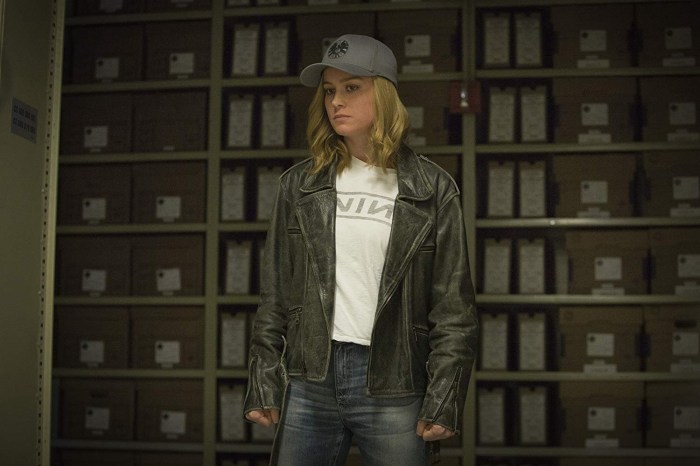
Though the look and general narrative feels stale, the six credited writers still do a brilliant job and one of the toughest tasks — addressing the character’s importance in her universe, but also our own. Over these last 11 years, Marvel Entertainment has produced a whopping 20 movies, the longest continuous story in film history. Though it undoubtedly took Feige far, far too long, he’s finally taking steps forward, in just the last 16 months delivering Thor: Ragnarok (the first directed by a person of color), Black Panther (one of the first predominantly black casts in a blockbuster film, and a groundbreaking step forward for black representation in cinema), Ant-Man and the Wasp (the first to feature a woman as the co-lead). Captain Marvel understands its groundbreaking place in this line of films, and expertly uses the platform to tell a story about being a female-presenting person in modern society. Whether Carol is dealing with Kree, humans, or the sci-fi embodiment of cultural norms, people continue to find reasons to tell her she can’t do something. When we finally see her overcome that and become Captain Marvel, it’s a breathtaking, powerful moment, one that stands up to anything else in the Marvel Universe.
Throughout the MCU’s first 20 entries, six have been origin stories. Boss Kevin Feige kept a high focus on hero-creation narratives in the early days of The Marvel Cinematic Universe, but has pared down in recent years, instead focusing on sequels and fully formed heroes in their own right — to mixed success. Where Ryan Coogler found success with this formula by beginning Black Panther in a world where T’Challa is already a hero, Spider-Man: Homecoming faltered. John Watts briefly flashed past Uncle Ben’s death and turned Peter Parker into a generic, quippy child, devoid of the motivation and buried tragedy that defines the character. With Captain Marvel, Boden and Fleck wisely go back to the origin story, allowing us to meet Carol Danvers before she inevitably groups up with The Avengers. Through a masterful grasp on tone, a bevy of strong performances and a hell of a moving climax, it bypasses every origin since we first saw Tony Stark break out of a cave with the first Iron Man suit. And now, 11 years later, we only have to wait two months before Captain Marvel becomes the one to save him, and connect fists with with the Universe — and her fists with Thanos’ face.

 Justin Don Jones