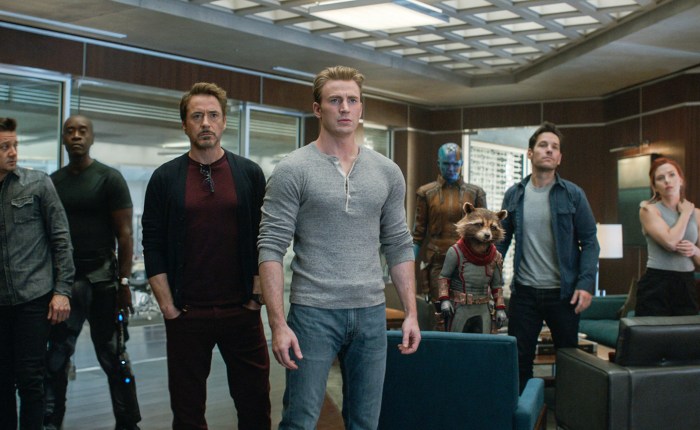
AVENGERS: ENDGAME Packs Marvel’s Strongest Emotional Punch to Date

AVENGERS: ENDGAME Packs Marvel’s Strongest Emotional Punch to Date

Originally published at Cinapse.co on April 26, 2019.

The Marvel Cinematic Universe is a wild achievement. The most ambitious project in cinema history and seemingly the only successful interconnected universe, it has attracted a massive amount of conversation over the last 11 years. The debates have ranged in topic from the usefulness of corporate art to the existence of Superhero Fatigue to Marvel’s lackluster color palette to the importance of representation to the Death of Cinema. Obviously, hyperbole has followed viewers at every turn, but it’s undeniable that producer Kevin Feige has engineered the franchise to dominate the cultural conversation, and it has for over a decade. And now we’re here at the “End,” whatever that means to a story defined by its inability to cease. With Avengers: Endgame, Marvel’s task was as large as the universe itself — directly follow-up Avengers: Infinity War, deliver a satisfying conclusion to this saga, and, most importantly, justify the existence of the last 21 films. Directors Joe and Anthony Russo, along with their writing partners Christopher Markus and Stephen McFeely, return as the first directors to make a fourth entry in the universe, and somehow, they pull off a massive success on every level. Miraculously, the team has created an overwhelming triumph on every front with the universe’s strongest, most impactful, and best entry to date.

The task of approaching a pre-release review for a film of this magnitude is tough, as I obviously want to stay entirely spoiler-free, but also need to figure out how to convey the truly momentous accomplishment of Endgame. Typically, this is the part of the review that features a brief breakdown of the plot and the characters, but how necessary could that possibly be for the 22nd entry in the biggest franchise ever, on a follow-up to a bonkers cliffhanger? So here’s all I can muster: Thanos won and killed half of the universe. The original six Avengers survived, plus a few of their less-important friends. Tony Stark is stuck in space. Captain Marvel is here now. They have to devise a plan and figure out just what it is superheroes do after suffering their greatest failure.

The closest thing to a main character in Avengers: Infinity War was Thanos, which finally added depth to a villain who’d been teased for six years, but sacrificed some of the time spent with the huge roster of heroes. As a result, the breakneck pace and disregard for character introductions put many off from the movie, making it feel more like a “fans only” experience than a standalone entry. In Endgame, the Russos fix some of these issues, but it’s not a 360-turnaround. Whereas Infinity War felt like the duo fully embracing their style of Marvel movie, convoluted plot and all, Endgamefeels more like a traditional Avengers movie. The added running time (and shortened character roster) provides breathing room, allowing the movie to be truly character-focused in the way that Joss Whedon’s two Avengers films were. And though this creates a more welcoming tone for viewers, the script is so saturated with reverence for the universe that even die hard series fans might miss moments, and newcomers could be entirely lost.

The secret of Marvel’s success doesn’t lie, like many other franchises, in grand stories that ape ancient myths or even the impeccable casting of heroes, but in the rewarding payoff of an intersecting universe. By placing all of their heroes in a single, frequently overlapping world, Kevin Feige helped create a series that is always seconds away from a little injection of fun from another time, place or tone. Need an Avenger to make your small-scale Ant-Man movie feel important? Boom, Falcon is here. Need to connect your space saga to the main story? Blam, Thanos pops in to act menacing. Not sure where to take the last Thor movie? Try popping in The Hulk just to see what happens. Sure, some of these were cheap ploys to achieve something the movie hadn’t earned, but it was almost always rewarding to see characters you love surprisingly stop in when you weren’t expecting them. Avengers films were meant to take that feeling and run with it for two hours, but nothing has ever quite succeeded in this regard like Avengers: Endgame. As the climax of the series, it delivers the longest and most powerful sustained payoff I’ve ever witnessed outside of the Japanese Zombie hit One Cut of the Dead (it rules). And once this thing approaches its third act, it ratchets up to a whole other level, packing in an entirely earned hour of pure bliss. Some are sure to deridingly call it fanservice, but when something is perfectly set up and well-earned, does that word even apply anymore? Nevertheless, the finale is so brilliant and so powerful, it justifies every moment that’s come before, even The Incredible Hulk and Thor: The Dark World.

In 2012’s The Avengers, Tony Stark knows that Loki has gone to Stark Tower because of his vanity: “He wants a monument built to the skies with his name plastered on it.” Avengers: Endgame is Marvel’s monument built to the skies. It’s massive, prideful, and unquestionably in love with itself. Viewers who’ve found themselves disenfranchised will find little to love, but True Believers will relish in every moment, callback, and interaction. And why wouldn’t they? This saga has been a comforting, reliable bit of positive escapism for the past 11 years, and now the fans and filmmakers are taking one last victory lap together. It’s with us till the end of the line.

Is the cutting-edge Hyperloop just a 300 mile-long pipe dream?

Classic 20th century science fiction writers imagined today as a hyper-futuristic world of flying cars, androids and off-planet colonies. Futurist Elon Musk, owner of SpaceX, creator of the Tesla and the real-life Tony Stark, has his own ideas on how to make this sort of reality possible. One of these is a groundbreaking technology that can send a person from Austin to Dallas in under 20 minutes.

This complex technology, known as Hyperloop, propels a levitating train car through an underground, low-pressure tunnel. Announced in a 2013 white paper, Musk hopes it can solve many modern transportation problems, including speed, safety and sustainability.

The long tube that the Hyperloop pod would travel down is what’s known as a vacuum, meaning it lacks any air, so air friction would not exist—but if the pod springs a leak, it’s very likely each passenger would die in seconds.

A NASA feasibility analysis of the Hyperloop concept last year analyzed Musk’s invention from a critical level, and they saw these potentially catastrophic possibilities early.

“The biggest issues with hyperloop technology are speed and scale,” the analysis said. “It is still unclear how to create a prototype that verifies the safety of the technology and allows testing of all necessary components.”

Working with SpaceX, a proposed solution is to use Hyperloop for cargo transportation only in its early years and expand upon that once safety is ensured. But for this process to even begin, it will need large-scale funding that Musk alone cannot provide.

Ex-Amazon Fresh coordinator Brittain Ladd said he hopes cooperation between SpaceX, Amazon and a state could lead to the acceleration of the project, provided a state is willing. For Ladd, the development of Hyperloop and Amazon’s current search for a second headquarters location could be knocked out with one stone, leading to a positive impact above ground as well.

“If Texas were to try and lure Amazon’s HQ2 to the state, what if the first thing they announce together is a high-speed rail station within HQ2?,” Ladd said. “If Amazon and the State were to work together and say ‘What if we actually built a Hyperloop from Laredo, El Paso, the border crossing, and instead of shipping on trucks, we’ll take them to Dallas.’ Imagine the great impact on the road and the environment.”

To further progress Hyperloop’s technology, Musk enlists the help of American students. In 2015, he started an annual Hyperloop Pod Competition, in which students from across the US compete to make the fastest, safest model of a Hyperloop pod to run on SpaceX’s test track in California. University of Texas electrical engineering professor Alex Claudel advises UT’s largest team, who have taken to calling themselves Guadaloop.

“So far all we could demonstrate was that it was working in a vacuum,” Claudel said. “We want to explore air bearing technology, we haven’t tested at high speeds.”

At last year’s competition, Guadaloop won the innovation award for their innovative use of air bearings. Texas’ other team, named 512 Hyperloop, made it to the final round but did not win an award. This year, the teams are shaking things up by working together as one group, and though growing pains are inevitable, they believe they can work best together.


Asian blockbusters prime for release on traditional New Year holiday

Originally published at The Daily Texan.

Many Southeast and East Asian nations celebrate Lunar New Year, and the films they watch fit into each country’s own distinct customs and traditions to honor
the holiday.

For 20 years, New Year films have dominated the Asian box office, and 2017 will be no exception to the trend. This year sees the release of “Journey to the West: The Demons Strike Back,” a sequel to one of the most successful New Year films. Even the U.S. will join in on the season this year. Zhang Yimou, one of China’s most popular directors, has a new fantasy monster film starring Matt Damon, “The Great Wall,” which will release in the U.S. a little over two weeks after Lunar New Year.

After Hong Kong pioneered the genre in the early ’80s, these blockbuster movies caught on in much of East Asia, but not in China, where films were not even  considered a commercial industry yet by the government, with entertainment films having to be imported from neighboring nations.

Chinese film and literature professor Yvonne Chang considered all films of the time propaganda.

“From 1949 to 1976 (films) were propaganda for educational purposes, but then they were shifted back to capitalist mode in the ’80s,” she said. “People studying in the west and from Hong Kong kind of had to introduce the idea of a commercial film.”

Chang credits the first Chinese New Year movie, Feng Xiaogang’s “The Dream Factory,” not just with introducing the genre to the mainland but for expanding Chinese film as a whole into a commercial industry, for better or worse.

“The emergence of New Year films had landmark importance because it opened up this very important position of commercial film in China,” Cheng said. “Commercial film started with Feng Xiaogang. But today, if you talk to Chinese people about New Year films, they are not so excited. They have grown into this mainstream dominant film, very much like Hollywood. After a few years, the films were not as well-made.”

After this initial growth spurt, New Year films ingrained themselves into East Asian culture, and became another one of the many ways people celebrate the holiday. Franny Fang, Accounting senior and president of the Taiwanese International Students Association, loves New Year films and the way they
celebrate culture.

“They’re really funny and you can watch them with your family,” Fang said. “It incorporates a lot of Taiwanese culture. They will use Taiwanese actors and Taiwanese slang.”

Yi Lu, UT alumna who earned a Ph.D. in radio-television-film after studying film at the Beijing Film Academy, said New Year films tend to be of the same comedic, yet shallow breed.

“At the beginning those films tried to create a story that really get into the holiday spirit,” Lu said. “But as time goes on, those are not necessarily this way, but they just try to make people laugh.”

But despite their superficiality, Lu said she loves the impact New Year films have and their newfound importance to culture.

“For Chinese people, the festival is very important to us,” Lu said. “The family gets together, eats and now watching films becomes a part of traditional
celebrating activities.”

“Inferno” packages thrilling nonsense in entertaining format

Originally published at The Daily Texan.

Two-thirds of the way through “Inferno,” a plot twist caused as many exasperated laughs as it did shocked gasps. This reaction defines the movie, as “Inferno” manages to be as contrived as it is thrilling.

Director Ron Howard first adapted Dan Brown’s bestselling conspiracy thriller novel “The Da Vinci Code” 10 years ago. The Tom Hanks vehicle was a self-serious labyrinth of a film but addressed a fascinating conspiracy. From there, the sequels have grown more bold, more entertaining and more convoluted.

In Howard’s latest adaptation, Tom Hanks’ Robert Langdon awakens in a hospital in Florence, Italy, unsure how he arrived there. This helps the story wisely skip the typically exposition-loaded first act and jump straight to the chase. Almost immediately, ambiguous groups begin firing at Langdon as he takes off to follow a trail left by a recently deceased billionaire, with his new female sidekick (Felicity Jones).

The mysterious puzzle is loosely tied to Dante’s “The Divine Comedy: Inferno,” but the film never gives a convincing reason why the epic poem figures so heavily into the story. For some reason, the billionaire who left the puzzle loved Italian art and Dante, using paintings as hints. Though entirely nonsensical, this enables Hanks to have strange visions of hell on Earth, including visually arresting sequences of heads turned backwards, people halfway buried in the ground and “The Shining”-like raging rivers of blood.

The plot unravels through flashbacks and plot twists, never really making much sense. In order to decode what actually happened in this movie, one would need a full day, a notebook and a symbologist as smart as Hanks’ character in the film.

Despite the disappointing plot, the entire cast is superb. Jones delivers a strong portrayal of a confused yet eager-to-help doctor, and she works surprisingly well with Hanks. Irrfan Khan is dynamite as the mysterious leader of a secretive corporation. His performance is convincing as a charmingly arrogant business man who is also an assassin with uncertain motivations — a ridiculous but extremely fun turn from the dramatic actor.

As Hanks’ character regains his memory, “Inferno” becomes less bold. Hanks’ freaky visions appear less frequently, and the movie starts to cave under its own weight, bending over backwards to make sense of the tangled plot. But “Inferno” never grows dull — whenever the plot hits a wall, its characters travel to another country, solve puzzles and dodge bullets there.

The film’s last flaw is its paint-by-numbers, typical Hollywood finale. For a series that finds its identity in being unpredictable, the ending comes up supremely disappointing. Further frustrating is the decision to stray from the conclusion to Brown’s novel, an ending as bold, preposterous and bizarrely awesome as the first 90 minutes of the film.

On the whole, Ron Howard’s “Inferno” is neither a good nor bad movie. It makes plenty of mistakes, but beautiful cinematography of historic buildings combined with an enjoyably absurd plot makes for an amusing time at the movies.

Those who are looking forward to “Inferno” should go to the theater, buy some popcorn and prepare for an awesome mess of a movie — but don’t forget your tin foil hats.

Superhero comics ditch distressed damsels for leading ladies

Originally published at The Daily Texan.

At New York Comic-Con in early October, Marvel announced its publishing lineup included 23 female-led comic books — its most ever.

By creating new heroes and reimagining classics, Marvel and DC are fully joining in the current trend of gender diversity in superhero comic books, and fans are grateful.

Andrew Friedenthal, a UT alumnus who earned a Ph.D. in philosophy and American studies, said he has noticed consistent mistreatment of women in comics.

“There’s been this kind of constant relegation of female characters into the background,” Friedenthal said. “The main thing that comes to my mind when I think of treatment of
women in comics is the ‘Women in Refrigerators’ trope.”

This recurring trend in storytelling spawned from a “Green Lantern” comic in 1994. In the issue, the villain brutally murders the male hero’s girlfriend and stuffs her into a refrigerator for the sake of revenge. This act’s only purpose within the narrative is to anger the male hero and give him greater motivation in his battle against his nemesis. It has gone on to become a symbol of the objectification of female characters in all forms of media.

Marvel has countered this objectification with female-led series across the board such as Kamala Khan, a new fan-favorite character, created in 2013. Just one year before, the preexisting hero Carol Danvers took up the mantle of the classic Marvel hero, Captain Marvel.

Angie Blackmon, owner of Dragon’s Lair Comics & Fantasy located in Austin, said although women have consistently been objectified, the industry’s current steps are a move in the right direction.

“I think Marvel really gets how to treat a female character,” Blackmon said. “There’s less of a tolerance for objectification and I think that makes a huge difference.”

Blackmon, however, said the turning point for women in comics came in 2005 when Wonder Woman was reluctantly forced to kill another character for the greater good, a theme found in many
male comics.

“It was the first moment where I felt like I was seeing her as a warrior in the same light that you’d see a male superhero,” Blackmon said.

English senior Jordan Tucker, who is writing her thesis on women in comics, said she takes issue with the type of people hired to write comic books.

“One of the worst things is they are writing more about women, but there aren’t that many women writing,” Tucker said.

In February, Marvel employed 18 female creators, but by December, 37 writers and artists will work there.

“There’s been more of a push to have female voices on the creative side of late,” Friedenthal said. “In terms of creating a strong female voice that is wholly identifiable, Squirrel Girl at Marvel is fantastic. It’s one of the best things out there right now.”

With every shift in culture, some pushback is bound to happen. Korey Finch, a comic book fan who has followed the industry for 15 years, has heard complaints about publishers potentially sacrificing the quality of the stories to cater to the demands of the audience. She doesn’t agree.

“I hear people whine about that a lot, and I don’t have a lot of tolerance for it,” Finch said. “Male superheroes have long oversaturated the comic book market, and the thought that some people  feel slighted by women taking more leading roles really angers me.”

Blackmon said she considers these issues growing pains along the way to achieving something greater.

“The important thing to remember is that there are going to be mistakes made,” Blackmon said. “I don’t think the companies are caving, I think they’re evolving.”

Diversity in filmmaking must be intentional

Originally published as guest editorial in The Daily Texan.

A study performed by USC Annenberg’s Institute for Diversity and Empowerment earlier this year found non-white representation in film rests at about 27 percent whereas the nation’s population is almost 38 percent non-white. And with the Oscars almost exclusively recognizing white men, it’s easy to conclude the American film industry has a diversity problem. These issues are deep-rooted and widespread, but the Austin-based collaborative film industry is a blueprint for a solution.

On a larger level, the problems are more than simply missed opportunities because they also extend to the roles given. Andrew Thomas, a Texas-native black student at the American Academy of Dramatic Arts said he expects “more calls from a Tyler Perry than a Christopher Nolan.”

Now there’s nothing wrong with Tyler Perry movies, and Madea fighting zombies is one of the best ideas of this generation. But Perry’s last directorial effort was a just OK, straight-to-DVD release which grossed just over $9 million, and “Interstellar” was a just OK, IMAX release which grossed $675 million globally.

These problems exist in every facet of the film industry at large, even as recently as DC Comics’ superhero film “Suicide Squad.” The character El Diablo, played by Jay Hernandez, is the only Latino lead in the — admittedly not very good — film. His character has a dark past as a former gang member with a hot temper, playing directly into wider stereotypes. And this is not its only problem, as the character Harley Quinn, played by Margot Robbie, is entirely defined by her adoration of her abusive boyfriend, The Joker — played by a miserable Jared Leto. Why is Warner Bros. in such fear of forging a new path to branch out and have a female Joker or a hispanic Batman?

Where Hollywood is failing, Austin is finding solutions. Pioneer Richard Linklater founded the Austin Film Society in 1985 with local film historian and UT professor Charles Ramírez-Berg, creating a more collaborative and inclusive atmosphere in Austin. Mexican-American filmmaker and former UT student Robert Rodriguez arrived in 1992 with his film “El Mariachi.” The welcome of Rodriguez to the scene is indicative of the atmosphere change spurred on by the Austin Film Society.

“It’s very competitive in Hollywood, whereas here the attitude is ‘Let’s help one another, and see how we can help one another,’” Ramírez-Berg said. “Therefore, everybody is welcome.”

Obviously the city of Austin is doing something right. The evident success of filmmakers like Robert Rodriguez and the positive remarks from people within the industry show a growth within the city not reflected in Hollywood. The city’s intentional desire for a communal atmosphere has obviously lessened the competition, which made the business more inclusive.

The solution for job opportunities for minorities and women is for the Hollywood blockbuster industry to adopt an intentional shift toward an Austin-like communal atmosphere. It is obviously productive in a business model, as “El Mariachi,” the first film by Robert Rodriguez, made its own budget back 285 times over in America alone.

Jones is a journalism junior from Irving. Follow him on Twitter @justjustin42.


VIDEO: Rangers’ Prospects Slugging Way Through Spring

VIDEO: Rangers’ Prospects Slugging Way Through Spring

Originally published on The Armchair All Americans in March 2016.

With roughly two weeks remaining of 2016 Spring Training, the Texas Rangers farm system is showing they earned the number seven spot in Baseball America’s organization rankings.

Few organizations have had as consistently great management as Texas; the team is always anticipating the arrival of at least one high-profile prospect. Their top three prospects, 22-year-old infielder Joey Gallo, 21-year-old outfielder Lewis Brinson, and 20-year-old outfielder Nomar Mazara, respectively.

They are all having phenomenal springs. Gallo is batting .333 with three homers, Brinson is batting .353 with one homer, and Mazara is batting .379 with a home run. Collectively, the trio is batting .357 in 70 at-bats. With that in mind, here is each player’s highlight of spring training (so far).

Top-Prospect Joey Gallo absolutely demolished a homer into the parking lot of Temple Diablo Stadium in a March 13th game against the Angels.

Outfielder Lewis Brinson hit a walk-off home run just a couple days ago, in a high-profile game at the Alamodome against defending World Series champions, the Kansas City Royals.

Nomar Mazara starting spring training with an absolutely beautiful homer on March second. I covered this just a couple weeks ago, but here it is again. Unfortunately, Mazara left yesterday’s game after fouling a ball off of his foot. He is listed as day-to-day.

For more analysis of the Texas Rangers, follow the author @justjustin42 on Twitter.

All stats provided by Baseball-Reference.com.  Featured Image Credit: (Smiley N. Pool/The Dallas Morning News)