All of Christopher Nolan’s movies are about exploring what scares him most

All of Christopher Nolan’s movies are about exploring what scares him most

Originally published at Polygon.com.

From Memento to the Dark Knight movies to the new Oppenheimer, one running theme links his stories.

In 2018, an interview with Oppenheimer director Christopher Nolan went viral — possibly because it was the first time he’d ever appeared relatable. In that conversation, he said his children sometimes jokingly call him Reynolds Woodcock, after the aloof, reserved protagonist of Paul Thomas Anderson’s Phantom Thread. Though Nolan’s scripts often feature signature, repeated (and often mocked) tropes, including time manipulation, dead spouses, and protagonists who face complex moral decisions, he injects very little of his own personality into his movies. Characters like Leonardo DiCaprio’s troubled team leader in Inception and Robert Pattinson’s equally troubled handler in Tenet are clearly styled after Nolan himself. But viewers rarely come away from Nolan movies with a greater understanding of his worldview, at least compared to the way directors like Martin Scorsese or Quentin Tarantino put their personalities on screen in every movie they make.

One underappreciated idea does recur over and over in Nolan’s work, though, and it surfaces again in Oppenheimer. The protagonists of many Nolan films become obsessed with a specific fear and go to great lengths to better understand or control their terror. In Nolan’s first blockbuster, Batman Begins, gangster Carmine Falcone (Tom Wilkinson) tells Bruce Wayne (Christian Bale), “You always fear what you don’t understand.” The quote acts as something of a guiding light not just for Bruce, but for Nolan’s back shelf of protagonists who seek a deeper knowledge of their phobias for the sake of control. In Oppenheimer, Nolan imprints this narrative device on a historical figure for the first time, and it feels like he’s being more open than ever about revealing what keeps him up at night.

There is no evidence that J. Robert Oppenheimer, the father of the atomic bomb, struggled with frightening visions of high-energy subatomic particles. This doesn’t come through in any documents about Oppenheimer the man, and Nolan seems to have added the idea to dramatize the film, as Oppenheimer periodically pauses to register and recoil from flashes of light, particles, and fire, all representing wordless fears he can’t explain. Though the movie’s dialogue never explicitly references these mysterious events, Nolan’s evocative imagery asks the audience to fill in the gaps themselves — are we seeing what’s in his mind, his future, or something else entirely?

Nolan’s Oppenheimer presents as an awkward, unsociable student with something off about him. It isn’t hard to imagine that he’s troubled by something. And what does this frightful student do? He dives deep into particle physics, devoting his life to understanding and attempting to control his fear — until it reaches critical mass.

The origin story in Batman Begins is the clearest example of this phenomenon: Batman’s vigilante persona was inspired by a traumatic childhood experience with bats. That plot point hews closely to Frank Miller and David Mazzucchelli’s classic 1987 comic arc Batman: Year One, but the film dives far deeper into Bruce’s fervent need to understand and control his terror. In a number of sequences featuring fear gas used by the movie’s villain, Scarecrow (played by Cillian Murphy, who also plays Nolan’s Oppenheimer), the filmmaker dips his toes into horror-inflected imagery. The Gothic architecture of Gotham combines with nightmarish sequences where villains see the superhero as a demonic monster, literalizing the metaphor of Bruce becoming his fear.

Following Batman Begins, Nolan’s Batman movies continue to dwell on this theme. Nolan assaults his protagonist with a series of villains who take on the shape of new nightmares. It’s as if he’s trying to teach Batman how to overcome the things he most dreads.

In addition to Bruce Wayne, the two protagonists Oppenheimer most resembles in this way are Leonardo DiCaprio’s Dom Cobb in Inception and Guy Pearce’s Leonard Shelby in Memento. The latter, Nolan’s mainstream breakthrough, focuses on a man with short-term memory loss who is so afraid of forgetting his purpose that he has it tattooed on his body. A significant portion of Inception takes place within Cobb’s dreams, which, through a very thinly veiled metaphor, are haunted by his wife Mal, played by Marion Cotillard. Guilt-ridden by the circumstances of her death, he subconsciously creates a murderous avatar in the shape of the shame he’s too afraid to face. He wrestles for control within his memory, attempting to hide her in a symbolic (and literal) basement in his mind. It doesn’t exactly work out.

Throughout Oppenheimer’s three-hour run time, Cillian Murphy’s protagonist struggles with existential horrors that are much larger than his personal regrets. In addition to the frightening visual bursts of atomic space, the film focuses most of its second-act tensions on the threat that the first atomic bomb test might ignite the hydrogen in Earth’s atmosphere. In real life, that threat was discussed and dismissed by the physicists at Los Alamos. But Nolan lingers on it, sending Oppenheimer to get the opinion of Albert Einstein, who acts as a sort of patron saint of science in the film. But Einstein provides no comforting answers, which ratchets up the tension and fear felt by characters and audience alike.

The threat of humans bringing about their own extinction is no new ground for Nolan’s films. And that may answer why, exactly, he’s so obsessed with fear and the war for control. In Interstellar, climate change devastates crops with a futuristic, dystopian blight. In his 2020 movie Tenet, an unseen society in the future attempts to reverse the flow of time to stop climate change before it gets out of hand. Between those two movies lies the World War II film Dunkirk, about the struggle for survival against a faceless threat. Though the Nazi presence implicitly hangs over the movie, Dunkirk doesn’t linger on a potential apocalypse in quite the same way as other Nolan movies. But the pervasive dread remains.

The fearsome final minutes of Oppenheimer drive this point home, as Nolan gives his protagonist a vision of a future devastated by nuclear apocalypse. His visions of dancing particles and flames give way to a clear, unambiguous doomsday — an uncountable number of rockets fire from an unknown country, streaking across the globe and detonating. Fire consumes everything.

Nolan’s devotion to the theme of people wrestling with their fears ties him to his protagonists, and his more recent focus specifically on humanity causing its own doom ramps that fear up to a universal level. It’s a heavy, existential worry, but it’s an illuminating glimpse into the mind of an artist who rarely lets the audience in. In his films, when a character obsesses about a topic, it typically means that’s the fear that keeps them up at night and drives them toward obsession as a means of control. Both Nolan and his iteration of J. Robert Oppenheimer are exposing their fears that humanity has the power to devastate life on Earth. And as climate change and political tensions simultaneously rise across the planet, it’s hard to blame him. 

How GM Treasury Drives the Company to a Sustainable Future

How GM Treasury Drives the Company to a Sustainable Future

Originally published at NeuGroup Insights.

GM’s aims for carbon neutrality by 2040 will rely on treasury’s contributions—from acquisitions to green bonds.

Treasury at General Motors is playing an active role and working closely with the business as the automaker moves away from producing vehicles with internal combustion engines (ICE) and pushes deeper into manufacturing electric vehicles (EVs).

Speaking at the pilot session of NeuGroup for Auto and Transportation, GM assistant treasurer Gustavo Vello described how treasury is helping the automaker achieve its strategic goals.

Gustavo Vello, GM AT

Joint effort, joint venture. Treasury directed the financing of three new vehicle battery-cell plants by negotiating the terms of a joint venture (JV) with LG Energy Solution (LGES) and securing a $2.5 billion loan for the JV from the US Department of Energy (DoE) under its Advanced Technology Vehicles Manufacturing program—one of the first loans closed since a 2010 deal with Tesla.

  • Treasury first partnered with GM’s corporate development and legal teams to negotiate the terms of the JV, called Ultium Cells LLC, including transfer price mechanisms, volume commitments and capital structure.
  • The loan due diligence process was extensive as GM and LGES declined to guarantee the loan (mitigating impact on the parent entities’ balance sheets and credit rating metrics), requiring the DoE to underwrite the loan based on the JV’s standalone credit risk. The DoE paid special attention to the JV’s financial projections, which were hard to calculate due to uncertainty about how quickly the market will transition to electric vehicles.
  • Mr. Vello said the loan from the DoE allowed Ultium Cells to borrow at “very attractive” rates based on Treasury yields compared to rates the JV could have obtained in the financial markets.
    • GM’s analysis of the loan, though, extended beyond interest rates. “We considered everything: financial covenants, approval rights, and all elements that may restrict the company’s ability to effectively manage its business.”
    • The process proved far more difficult than a typical loan for GM because the JV was evaluated as a new company in a new industry, whereas GM benefits from being a large investment-grade issuer.

Ensuring access to key raw materials. Globally, demand for battery raw material (BRM) has increased significantly due to projected EV production, resulting in concerns that supply deficits and elevated commodity prices could persist through 2030. That is another challenge treasury is helping address.

  • “As you can imagine with all the industry transition to EVs, there’s not enough raw material for everybody,” Mr. Vello said. “What’s happening right now is a race to get that capacity, and prices are really skyrocketing.”
  • So GM’s treasury team joined a major internal effort, working with purchasing, corporate development and legal teams to structure deals to obtain required BRM volumes at lower prices. These strategies include purchasing commitments, loans and equity investments to create or expand mining capacity in stable locations—like GM’s $650 million investment in Lithium Americas, announced last month.
    • In addition to benefiting suppliers through direct investments and revenue certainty, Mr. Vello said the deals lend credibility to the smaller miners and manufacturers, “so they can raise capital more easily from other investors.”
  • Mr. Vello added that, though there is a market to hedge cobalt and lithium hydroxide, it’s “very young,” with low liquidity and high costs. “We expect that to improve over time as demand grows.”

Putting the pieces together. GM’s aggressive plans to eliminate emissions from most vehicles in the US by 2035 also means significant investments in assembly plants are needed. Although the company’s cash generation has been robust, treasury took advantage of favorable pricing by launching the company’s inaugural green bond ($2.25 billion) in August 2022.

  • GM first had to launch a sustainable finance framework that allows it to borrow funds to finance projects associated with clean transportation solutions and social initiatives. Treasury led this process, working with two bank advisors and with support from the company’s legal, sustainability and investor relations teams.
  • A few days after launching the framework, GM issued the green bond. “It was an excellent opportunity to communicate the GM EV story to fixed income investors and better align our capital structure and funding to our journey to zero emissions,” Mr. Vello said.

Cruising ahead. Another initiative, and one with a longer time horizon, is to realize the company’s plans to move to autonomous vehicles. After helping acquire Cruise Automation—a start-up developing autonomous driving technology—in 2016, treasury supported several capital raises from financial and strategic investors such as Softbank, Honda, Microsoft and Walmart.

  • Treasury contributed to those transactions by performing valuations, evaluating comparable companies, conducting cash flow analysis and contributing to capital structure and governance rights negotiations.
  • Treasury also worked with GM Financial to offer a $5 billion credit line to Cruise to help fund its fleet of autonomous vehicles—which will be instrumental as Cruise looks to expand its commercial operations in San Francisco, Phoenix and Austin.

ChatGPT, AI and the Future of Finance: An FP&A Leader’s Vision

ChatGPT, AI and the Future of Finance: An FP&A Leader’s Vision

Originally published at NeuGroup Insights.

Baxter International FP&A head Aaron Bloomer shares insights on how FP&A can lead finance into the digital future.

The buzz surrounding the OpenAI tool ChatGPT has highlighted the power of artificial intelligence and the potential for AI to bring the future of finance forward—in ways that will further disrupt and transform finance organizations.

  • That’s the jumping-off point for a lively Strategic Finance Lab podcast conversation between NeuGroup’s Justin Jones and Baxter International vice president of FP&A Aaron Bloomer about AI, advanced analytics and the leading role finance should play as corporations turn insights derived from data into strategic action.
  • Watch a video clip from the podcast by hitting the play button below. Then listen to the full interview by heading to Apple or Spotify.

Sending More Cash Out of China Using Pools in Free Trade Zones

Sending More Cash Out of China Using Pools in Free Trade Zones

Originally published at NeuGroup Insights.

Unpacking a member’s cash pool in China in a free trade zone where window guidance put no limit on cash outflows.

Many NeuGroup member companies face a challenge getting cash out of China—in part because of rules limiting outflows from cash pools set up under a so-called nationwide scheme to 50% of the net equity held by a company’s entities in the country. But not all multinationals have this problem.

  • At a recent session of NeuGroup for Global Cash and Banking, one member intrigued peers by describing how his company is taking advantage of free trade zones (FTZs) established in China that do not have specified limits on outflows, where corporates rely on unpublished “window” guidance provided by regulators.
  • That prompted the member’s company to set up a special cross-border, physical RMB pool, based in Shanghai, which sends cash via intercompany loans to a multicurrency notional pool based in Singapore, which is pooled under a dollar header account and sent to the US.
  • “China is a big entity for us, with trapped cash,” the member said. “We’d been studying this for the past year.”
  • One of the members who was unaware that companies could send more than 50% of equity out of China said he would immediately contact his team to look into following suit.

How it works. To benefit from the relaxed outflow rules governing free trade zones (FTZ), the member company set up a cross-border cash pool made up of three accounts (see graphic below):

  1. A pool header operating account, onshore in China, which consolidates cash from all the corporate’s RMB subaccounts in the country.
  2. A special cross-border account in the Shanghai FTZ that sweeps domestic cash and retrieves overseas cash. This requires an application and approval from the People’s Bank of China (PBOC), which the member said can take one to two months.
  3. An offshore header account in Singapore that receives the cash, sent in CNY and received in CNH.

Another corporate’s liquidity director told NeuGroup Insights his company has a similar, special pooling account, also based in Shanghai. “Under the terms of this pooling structure, we can move unlimited amounts of cash, the only major requirement being that at least one time per year we have to have a zero balance for the sweep—meaning we have to repay all of the funds sent out of country for one day,” he explained.

A true team effort. The US-based member who described the structure at the meeting said setting it up was relatively complex as it required government approval and a very hands-on team in Asia, starting with a regional treasurer in Singapore.

  • He said the Singapore team obtained approval from the PBOC and worked with a local bank to set up the accounts. “We’re stepping in now to coordinate from the US side to make sure that we provide liquidity, interest rates, deposits, and make sure we’re fully covered,” he said.
  • The regional treasurer said that because China is “very paper-based,” she depended on a China-based treasury manager to propose banks for corporate approval, set up the facility’s infrastructure and get approval from regulators. The treasury manager followed guidance from the PBOC and the State Administration of Foreign Exchange.
  • “He is the one who is running around, talking to banks, talking to peers—this takes time and expertise,” the regional treasurer said. “If you do not have suitable people in country, it’s not easy; you wouldn’t be able to do it if you’re sitting in Singapore.”

Why not do it? Some multinationals that use the nationwide pooling scheme and have not opted to take advantage of the increased flexibility offered in China’s FTZs simply don’t have operations in the special regions necessary to set up a pool header account.

  • “The free trade zones are not everywhere,” one member said. “So if your company is in Shenzhou, you cannot do the free trade zone version. The FTZ is intended to attract people to concentrate imports into certain areas.”
  • They said in addition to having a FTZ designation, an eligible corporate considering the special pooling structure should have multiple entities in China. A corporate with only one account in the country may use repatriation via a dividend to move cash out of the country.
  • A NeuGroup member at a company using the nationwide structure told NeuGroup Insights: “We are aware of the other schemes, and continue to evaluate.  We have had a positive partnership with regulators in developing and operating our existing structure and it has largely met our needs. We also believe this nationwide scheme offers the greatest stability and predictability, which is important to us both locally and globally as we manage liquidity.”

Words to the wise. Indeed, the regional treasurer warned corporates weighing the benefits of pools in an FTZ to be wary of ever-changing window guidance from the PBOC.

  • “I want to put a disclaimer that this was a chance for us to take advantage of China opening up because of how the economics have evolved,” she said. “But there is a chance that, even tomorrow, they could change the regulation—and they don’t have to give advance notice.”
  • And don’t expect to get parameters documented in writing. For guidance on FTZ RMB pool outflows, “even the bank won’t write an email to you, they’ll only tell you over the phone,” the team member in Shanghai said.

The Importance of Timing When Buying Political Risk Insurance

The Importance of Timing When Buying Political Risk Insurance

Originally published at NeuGroup Insights.

Laura Burns of WTW explains the benefits of policies that insure losses caused by geopolitical crises in episode nine of NeuGroup’s Strategic Finance Lab podcast.

Russia’s escalating war with Ukraine and rising tensions between the US and China are two big reasons why multinational corporations might want to consider buying political risk insurance—in other regions of the world, where it’s not too late to find coverage.

  • To learn what corporates need to know about political risk insurance, hit the play button below or head to Apple or Spotify and hear insights from Laura Burns, who heads the political risk practice for WTW, formerly known as Willis Towers Watson. She joins NeuGroup Insights writer Justin Jones on the latest Strategic Finance Lab podcast, recorded in August.
  • Political risk insurance policies fill gaps in traditional property insurance policies, picking up where other coverages drop off, Ms. Burns explains in the podcast.

Ms. Burns also discusses how growing up in Bermuda with family in the insurance business provided an up-close view of innovations in insurance policies and, along with a lifelong enthusiasm for international affairs, made political risk insurance the perfect job for her.

  • “I discovered this little niche called political risk insurance, and I thought, ‘well that’s interesting, marrying the family business with my particular interest in geopolitics,” she says. “I would say this is the best-kept secret in the business.”

Bloomberg Terminal Inflation: ~9% Price Hike on Jan. 1, 2023

Bloomberg Terminal Inflation: ~9% Price Hike on Jan. 1, 2023

Originally published at NeuGroup Insights.

Terminal subscriptions will rise $195 per month, Bloomberg tells clients, citing global inflation.

In a move that will affect many corporations and their banks, Bloomberg is raising the cost of subscriptions to its financial data Terminal by about 9%, citing rising expenses for labor, materials and “escalating competition for talent,” according to a letter from the company to clients dated Aug. 25.  

  • The increase will bring the total cost to $2,500 a month or $30,000 a year for a single Terminal. Multiple Terminal subscriptions will cost $2,215 a month or $26,580 annually. Bloomberg subscriptions are for two years.
  • “Starting January 1, 2023, Bloomberg Terminal subscriptions will see a price increase of 9.65% for locations with multiple licenses (8.46% for single subscriptions),” Bloomberg’s letter states.
  • “The price increase in nominal terms will be $195 per month per subscription. This is consistent with Bloomberg’s historical practice and links our price increase to global inflation,” it adds.
  • A Bloomberg spokesperson confirmed the price increase but declined to comment on feedback from clients or to provide data on past price increases.

No big surprise. One NeuGroup member said the increase was not surprising “given the current state of global inflation.” He noted that “pricing is determined by the install date; if a contract is signed on 12/15/22 but the Terminal itself is not installed until 1/15/23, then this license will be billed at the 2023 rate.”

  • The member said his company does not expect to make any changes immediately in response to the price hike. “Like most companies, we periodically review our service providers and consider pricing together with other service and quality factors,” he said. “We would conduct any service provider reviews as the contract expiration approaches.”

Weighing the Impact of Inflation and ESG on Tech Credit Ratings

Weighing the Impact of Inflation and ESG on Tech Credit Ratings

Originally published at NeuGroup Insights.

Credit rating agencies sit down to weigh in on hot topics with Tech20 treasurers at the annual breakfast panel.

Each year, members of NeuGroup for Tech Treasurers sit down with tech sector analysts from S&P, Fitch and Moody’s to discuss their pressing questions for the credit rating agencies. This year’s conversation revolved around the hot topics of inflation and ESG. One important takeaway: there’s not much for tech companies to worry about (yet).

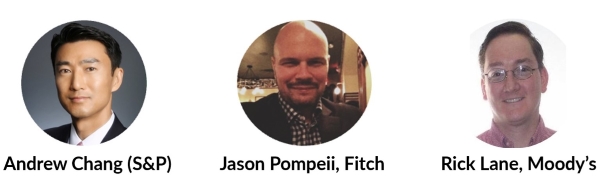
  • The chief lending officer at meeting sponsor BNY Mellon moderated the discussion with Andrew Chang, director of corporate ratings at S&P; Jason Pompeii, senior director of corporates at Fitch Ratings; and Rick Lane, senior vice president at Moody’s.
  • A selection of questions and answers follow, and have been edited for clarity and brevity.

Question: Inflation is rising at its fastest pace in decades, fueled in part by surging demand, increased consumer spending and supply chain disruptions. What are your inflation expectations for 2022 and how might rising prices affect tech companies’ credit ratings?

Mr. Lane (Moody’s): “My sense is that inflation is not going to be as strong as what some people suspect. Especially with this group here, there’s a deflationary element to what everyone in the tech sector does; they’re not as exposed to some of the cost pressures as other sectors.

  • “Intellectual property and software are less exposed to inflationary pressures, and though supply chain is an issue for some folks here, it could be a 1% to 2% impact in the short-term. It’s a cost that can be well-accommodated in the business model and the credit rating.”

Mr. Chang (S&P): “I’m sort in the same camp as economists that view it as transitory, though that word has certainly been overused this year. But we view it as transitory with the caveat, at least from S&P, that it’s been stronger and longer than we had anticipated, but still transitory.

  • “Customer prices will be permanently higher as a result, and if that’s not offset by higher wages then purchasing power will be falling, which would slow demand and bring inflation back to target. While it looks out of control for now, our economists still view it as transitory.
  • “From a tech perspective, the inflation concern is a limiting factor. Companies have costs that are rising and supply constraints, but have been able to pass along the price increases to consumers, and their customers have been willing to accept higher prices because they are in need of the tech supplies, so we don’t see that impacting our view of the credit.”

Mr. Pompeii (Fitch): “I think there’s already been an indication of the slowdown in bond repurchases, there’s an expectation that rates will rise in 2022. It’s important to remember that, obviously, there’s a lag effect there.

  •  “We do expect there to be inflation in the meantime; though our institutional view remains that it’s largely transitory, we still expect it to be extending well into 2022. I think this all makes sense in the context of the supply and demand picture, and all of the government intervention taking place that is unprecedented in our lifetimes.
  • “Expect things to start normalizing in 2023. We have very low interest rates, obviously, but it’s difficult to get too concerned about [inflation] at this point.”

Question: What steps are the credit agencies taking to provide transparency and visibility into the role ESG factors have on ratings?

Mr. Chang (S&P): “With our ESG credit indicator, we’re trying to call out ESG factors that are already being integrated in the ratings. They’re mostly neutral for tech, unlike oil and gas for example.

  • “This is largely investor-driven, as fixed-income investors want to know or want a picture of ESG factors on their credit ratings. One differentiating factor from third-party ESG raters is we have a line of communication with every issuer, we actually get to talk to the treasurer and get a more granular view of ESG, which benefits fixed-income investors.
  • “One question asked consistently in our calls with issuers is that some were disappointed that they, as a large hardware/software provider, are proactive in tackling these ESG factors and they should be rated higher on a score from one to five.
  • “Our response is that the ESG factor has to be significant enough to impact the overall credit to be a one, for example. A two is our neutral score, which the majority of tech issuers get. It’s a pretty high bar to get to a one.”

Mr. Pompeii (Fitch): “At Fitch, what we’ve done is focused more on the importance of the discussion of ESG. These are factors we’ve always looked at, so it’s really just a reflection on how significant that discussion is.

  • “Not unexpectedly, it really comes down to, for the most part, governance and the shareholder concentration and private equity ownership. Those sorts of things are most common instances where we would say this is more important.”

Mr. Lane (Moody’s): “We’ve begun to roll out ESG scores for a number of companies, we’ve just done some preliminary drafting for the tech sector amongst others. We’ve got 21 ratings in our ratings system, but for ESG we’ve got five ratings. A one is extremely rare, and a five is also pretty rare, so there are really only a few ratings we can have.

  • “We’ve always incorporated ESG into our ratings, we simply had not called those out, so we’re becoming granular and transparent about this and their credit rating impact. Our efforts now on the ESG front are going to be a bit more transparent and break out the environmental, social and governance issues.
  • “We’re not taking the approach of sustainability aspects, we’re speaking of ESG factors as they relate to credit ratings. Over time, we may become more quantitative and use third-party data, but that’s not where we’re starting off.”

Question: Are there any updates on cybersecurity and how that can impact credit ratings? [Earlier this year, Moody’s sent a cybersecurity survey to some issuers.]

Mr. Chang (S&P): “The cybersecurity issue is embedded in the G side of our ESG program. To the extent that the company makes a serious error, those things will be reflected on the governance side and potentially on the credit rating, but I don’t believe we’ve taken memorable ratings actions yet.”

Mr. Pompeii (Fitch): “At this particular point, our response to that has been pretty reactive. I can think of a couple of cases in which we perhaps would put out a comment or maybe provide an outlook based on an event that maybe wasn’t strictly due to cybersecurity issues.

  • “It will be interesting to see how we’re going to be able to assess, objectively, the steps that are being taken from a cybersecurity standpoint. I think over the medium-term, what we’re doing will be to the extent that disclosure does not meaningfully change our ratings.”

Mr. Lane (Moody’s): “We’ve put out a lot of research on cybersecurity, we’ve got a growing group that’s focused on that more elevated risk aspect, especially from an operational/reputational standpoint.

  • “A fair bit of our work is reactive, commenting on particular instances. Over the next few years, we’re going to try to sharpen our pencils and be a bit more proactive, but at this point it’s more observatory.”

Google’s Treasury Transformation Search Results: Teaming up With SAP

Google’s Treasury Transformation Search Results: Teaming up With SAP

Originally published at NeuGroup Insights.

Google’s co-innovation of treasury solutions that work with SAP S/4HANA could benefit other corporates.

Google’s frustrations with building its own customized treasury tools to enhance its ERP ultimately pushed the company to abandon that strategy. Today, it’s using standardized solutions it co-created with SAP that are now built into its cloud-based S/4HANA platform. Among the beneficiaries: other corporates that use S/4HANA that can make use of tools Google helped innovate.

  • Over a two-year implementation of SAP that Google called Project Emerald, the company used its resources—time, people and money — to develop solutions for hedge management and liquidity and payments—improvements now offered to all SAP clients.
  • In a meeting of NeuGroup for Foreign Exchange 2 and a conversation with NeuGroup Insights, Shaun Hazen, Google’s head of financial risk strategy, and Kathy Makowski, a business systems analyst, discussed the co-innovation process and its advantages.
    • “We knew that we had to co-innovate with SAP to make it standard,” Mr. Hazen said. “And now everything we’re using today is standard in SAP, it’s not any unique customization.”

Building the right team. For the entirety of the project, treasury members and engineers within Google were re-prioritized, laser-focused on implementing and co-innovating with SAP.

  • “We deprioritized other projects to create bandwidth,” Mr. Hazen said. “The people that were put on the project were more senior, so we weren’t pulling off the operational team members—it was people that had done the operational work and now had moved into more senior roles.”
  • To ensure the project ran smoothly, the company hired project managers to oversee operations across the company’s different divisions.
  • Google’s treasury team worked with internal engineers and SAP to make multiple enhancements to the software’s hedge management capabilities and exposure management trading interface.

The spirit of co-innovation. It’s worth noting that Google, like all SAP customers, could have requested that the vendor provide enhancements or additional modules. But such requests are pulled into a queue and prioritized based on factors chosen by SAP.

  • “One of the great benefits of co-innovation is you’re putting your resources where that request is,” Ms. Makowski said. “’Hey, we’re willing to also invest our time in this in order to bump it to the top of the list.’
    • “So it’s not just up to them to build, develop and test it. We want to be involved and we’re willing to give resource time in order to do that.”
  • “SAP also had a lot to benefit from,” Mr. Hazen said. “The spirit of co-innovation is in each team bringing a similar amount of resources and expertise.”

Key goals. To start, Google treasury laid out initial, attainable goals focused on creating an integrated treasury platform that is scalable, using automated processes and real-time data to support and create value.

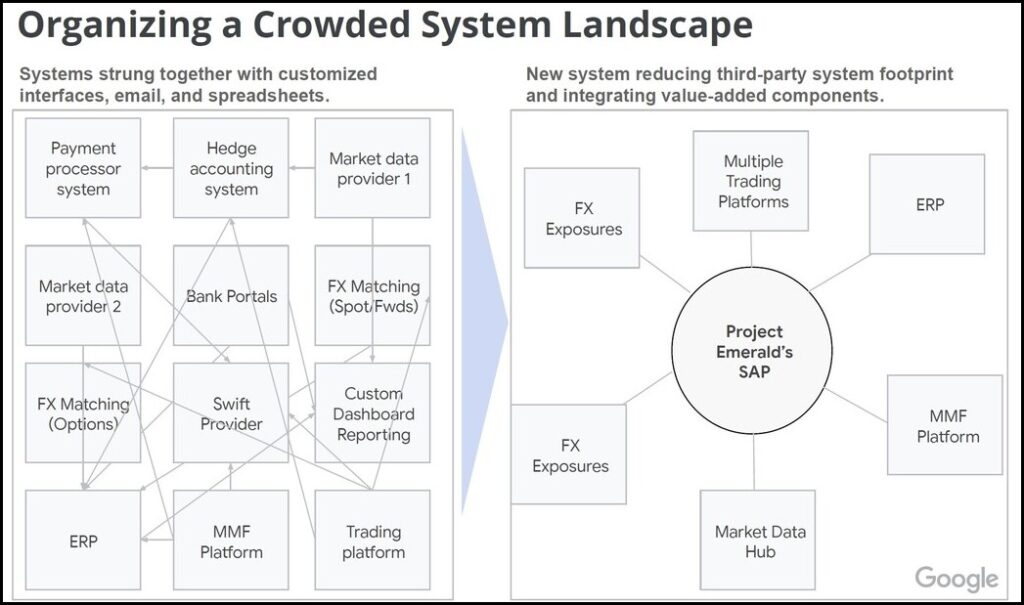
  • A key objective was connecting the team’s separate systems to a central SAP platform without any need for add-ons. As the chart below shows, a spiderweb of connections and systems was streamlined and simplified. Other benefits included:
    • Centralization of banking information into one source through access to electronic bank statements and reporting.
    • Reducing operating cash balances.
    • Enabling in-house banks, including intercompany loan management, netting, settlements and accounting and better liquidity forecasting.
    • Increasing control and standardization of transaction and reporting.
    • Integrating transactions to provide yield automated cash forecasting and liquidity management.

Closing gaps, avoiding customization. From the beginning of the implementation project, one of Google’s primary tenets was minimal customization given the difficulties encountered with its previous ERP.

  • Those customized additions required constant effort to integrate with third-party data providers and systems. “Maintaining that over time as these systems and infrastructures change takes resourcing,” Mr. Hazen said.
  • “Any time you go to customize a pre-delivered tool, you end up with a lot of issues during upgrades,” Ms. Makowski said. “So SAP helped us identify gaps and helped us close those gaps.”
  • One of them: S/4HANA lacked some foreign exchange capabilities that Google desired. “We went back to [SAP] and asked [about] their capacity to have standard solutions for our high priority items,” Ms. Makowski said. “We worked directly with them [while] gathering requirements, and then again in the build.”
  • “Google has put a lot of thought into how we do our hedging and risk management programs,” Mr. Hazen said. “We brought our hedging policies, our analytics, how we make decisions” to meetings with SAP to decipher what a system component would look like.

A new standard. “This became a standard for other companies, a pre-delivery service SAP can offer,” Ms. Makowski said. “It was advantageous on both sides, because SAP can then improve their product.”

  • Though Google’s business team identified the necessary features and improvements, they left the design to SAP. This allowed SAP to design it in a way that leveraged Google’s inputs but wasn’t Google-specific.
  • “For example, when our traders are preparing to execute trades, they will sometimes net several smaller trades together and/or vice versa, split out one large trade to several smaller ones,” she continued. “Google’s input was on the requirements, but SAP designed where, when and how that functionality would work best to accommodate as many companies as possible.”

The now-standard improvements include:

  • Hedge management and trading:
    • Multi-platform support for trading, confirmation, and settlements.
    • Integration with upstream modules to generate FX trade requests.
    • Dedicated trading application for structuring, assignment and routing of requests.
    • Fulfillment process to validate that executed trades conform to what was approved.
    • Alignment with U.S. GAAP requirements.
  • Liquidity and payments:
    • Forecast hub that enables the full use of SAP cash forecasting capabilities through direct integrations with non-SAP inputs (payroll, collections, etc.).
    • Automated intraday cash reconciliation against forecasted items.
    • Ability to raise FX trade requests directly in the cash position, supporting onshore and intercompany FX settlements.

Control Rod: Using Innovative Ideas to Move Beyond Best Practice

Control Rod: Using Innovative Ideas to Move Beyond Best Practice

Originally published at NeuGroup.com. I edited and co-produced the video, and assisted in writing the copy below.

Medtronic treasurer Tim Husnik shares another NeuGroup Advantage: innovation.

Achieving best practice is one thing. Being exceptional is another.

  • For Medtronic senior treasury director Tim Husnik, fostering a culture of innovation has proved successful at boosting the company beyond best practice, which he considers the baseline.
  • “I hate to say this, but best practice is just like being average. You’re as awesome as the most average multinational corporation,” Mr. Husnik said. “It’s not quite aligned to our company mission of being extraordinary and innovative.

The NeuGroup advantage: beyond best practice. Watch the video below for Mr. Husnik’s full thoughts on how treasurers can reach for “legendary practice” by becoming a control rod for team members’ ideas: